


29.08.2026
How to Learn German Vocabulary That Sticks
Learning German vocabulary can feel overwhelming. You learn a new word today, recognize it tomorrow, and then completely forget it a week later.
The problem is usually not your memory. It is how you learn the words.
Simply reading word lists or repeating the same vocabulary over and over is rarely enough. To actually remember German words, you need to meet them repeatedly, use them in context, and actively recall them.
In this guide, you'll discover 7 effective methods for learning German vocabulary and remembering it long-term.
1. Learn Words in Context, Not in Isolation
One of the biggest mistakes German learners make is memorizing individual words without context.
For example, you might learn:
vermeiden — to avoid
But simply memorizing the translation doesn't tell you how Germans actually use the word.
Instead, learn it in a sentence:
Viele Menschen vermeiden bestimmte Themen.
Many people avoid certain topics.
Now you can see the word in a real grammatical structure.
Context also helps you remember vocabulary because your brain connects the word with a situation, meaning, and other words.
Instead of learning:
vermeiden = to avoid
learn:
etwas vermeiden
eine Diskussion vermeiden
bestimmte Themen vermeiden
This gives you several connections to the same word.
Try this:
Whenever you learn a new German word, ask yourself:
-
What does it mean?
-
How is it used?
-
What words usually appear with it?
-
Can I create my own sentence?
The more connections you create, the easier the word becomes to remember.
2. Use Spaced Repetition
You don't need to study every word every day.
In fact, constantly reviewing the same vocabulary can be inefficient. A better approach is spaced repetition.
The idea is simple: review a word shortly before you are likely to forget it.
For example:
-
Day 1: Learn the word
-
Day 2: Review it
-
Day 4: Review it again
-
Day 7: Review it
-
Day 14: Review it
-
Day 30: Review it
Each successful recall strengthens your memory.
The important part is that you should try to remember the word before looking at the answer.
Seeing a word and thinking "Oh yes, I know this" is not the same as actually recalling it.
3. Stop Relying Only on Recognition
There are two very different things:
Recognition:
You see verdrängen and think, "I know this word."
Recall:
You see to suppress / repress and have to remember that the German word is verdrängen.
Recall is much harder — and much more useful.
If you want to speak German confidently, your brain needs to retrieve words without being given the answer first.
That's why vocabulary exercises should include tasks such as:
-
German → English
-
English → German
-
Fill in the blank
-
Multiple choice
-
Complete the sentence
-
Use the word in your own sentence
The harder your brain has to work to retrieve a word, the stronger the memory can become.
4. Learn Word Families
German becomes much easier when you stop treating every word as completely separate.
Many German words belong to the same word family.
For example:
entscheiden — to decide
die Entscheidung — decision
entscheidend — decisive / crucial
unentschieden — undecided
Learning these connections allows you to expand your vocabulary much faster.
Another example:
verändern — to change
die Veränderung — change
veränderbar — changeable
Instead of memorizing three unrelated words, you start seeing the underlying pattern.
This is especially useful from B2 level onward, when German vocabulary becomes increasingly complex.
5. Learn Synonyms at the Right Level
Knowing one German word is useful. Knowing several ways to express the same idea gives you much more flexibility.
For example, instead of always using:
machen — to do / make
you can learn more precise alternatives:
durchführen — to carry out
erstellen — to create
verursachen — to cause
bewirken — to bring about
unternehmen — to undertake
But don't try to memorize dozens of synonyms at once.
Choose words that are appropriate for your current level and learn the differences between them.
For example:
B1:
machen
B2:
durchführen
C1:
bewirken / veranlassen
This helps you gradually build a more sophisticated vocabulary.
6. Use New Words Immediately
A word becomes much easier to remember when you actually use it.
Suppose you learn:
die Selbstkontrolle — self-control
Don't just read the definition.
Create a sentence:
Selbstkontrolle spielt eine wichtige Rolle im Alltag.
Then try to create another sentence about your own life:
Beim Lernen brauche ich viel Selbstkontrolle.
You can also try saying the sentence out loud.
The goal is to move vocabulary from passive knowledge to active vocabulary.
Passive vocabulary consists of words you understand when you see or hear them.
Active vocabulary consists of words you can actually use yourself.
And active vocabulary is what you need for fluent communication.
7. Build a Personal Vocabulary System
The final method is perhaps the most important one:
Create a system you can actually maintain.
Don't try to memorize 100 new German words every day.
It is much better to learn 10 useful words and review them consistently than to learn 100 words and forget most of them.
A good vocabulary system should allow you to:
-
Save new words quickly.
-
Add meanings and translations.
-
See words in context.
-
Review them regularly.
-
Test your memory.
-
Track your progress.
This is where a digital vocabulary tool can make a big difference.
Instead of keeping random vocabulary lists in notebooks, notes apps, and screenshots, you can keep everything in one place and turn your vocabulary into an organized learning system.
The Key: Don't Just Collect Words — Learn Them
The goal of vocabulary learning isn't to have thousands of words in a list.
The goal is to be able to recognize, recall, and use them when you need them.
If you learn a word once and never see it again, you will probably forget it.
If you encounter it in context, review it with spaced repetition, actively recall it, and use it yourself, the word becomes much more likely to stay in your long-term memory.
So the next time you find a new German word, don't just write down the translation.
Learn it. Use it. Review it. And come back to it.
That's how vocabulary becomes a part of your German — instead of another word you once knew.
Start Building Your German Vocabulary
Worty is designed to help German learners discover, save, review, and learn new vocabulary in a more effective way.
Instead of simply collecting words, you can turn the vocabulary you encounter into a personal learning system and practice it through different types of exercises.
Because knowing a word isn't the same as remembering it.
More Articles
5 Important German Connectors You Need to Know
15 German Modal Particles You Need to Know
Learn 15 common German modal particles like doch, mal, ja, schon and denn — what they mean and how to sound more natural.
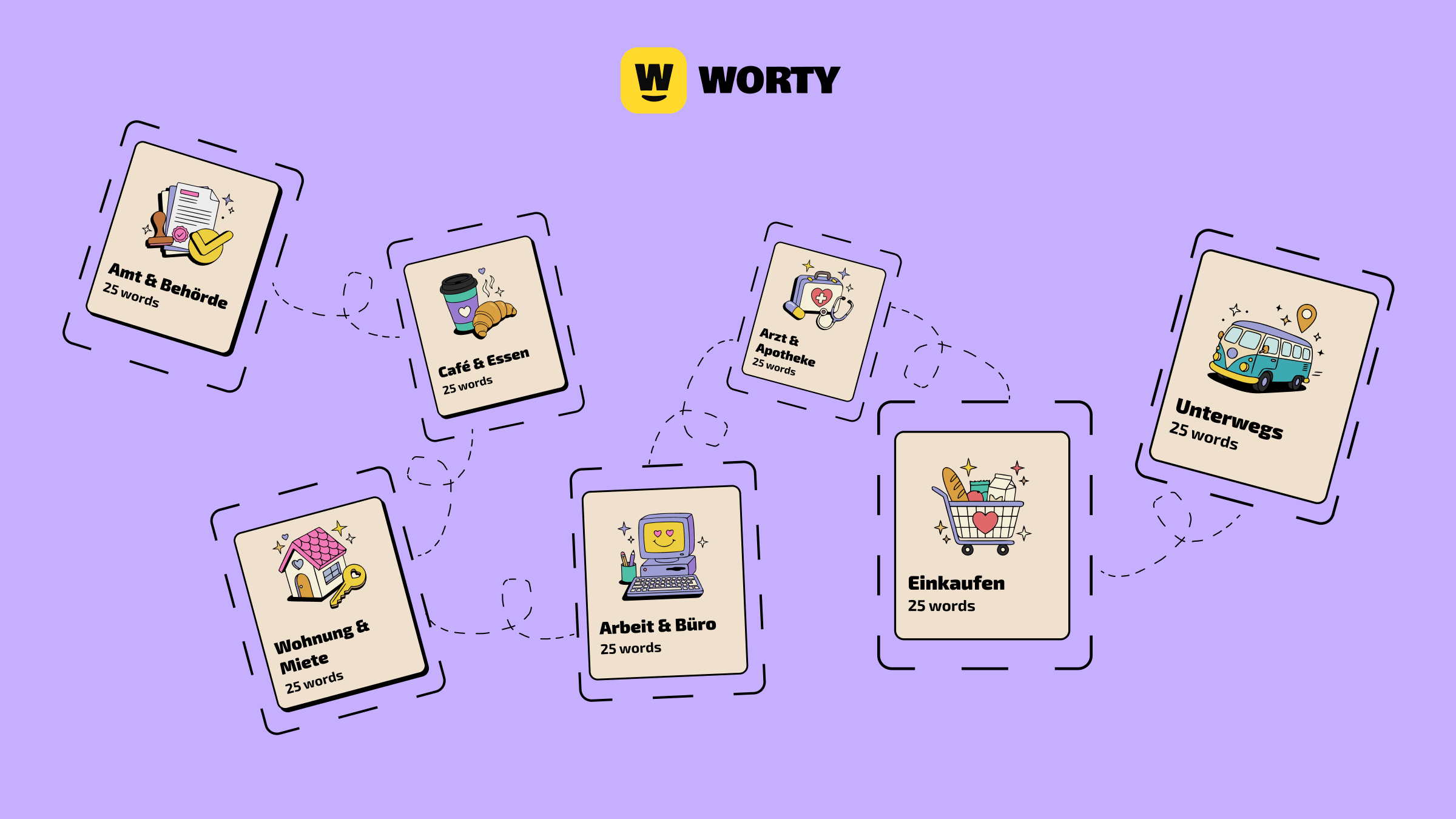
New German Vocabulary Card Decks for Everyday Life

8 German Antonyms You Should Know