


27.09.2026
5 Important German Connectors You Need to Know
German connectors help you connect ideas, explain relationships between sentences, and make your German sound more natural and advanced.
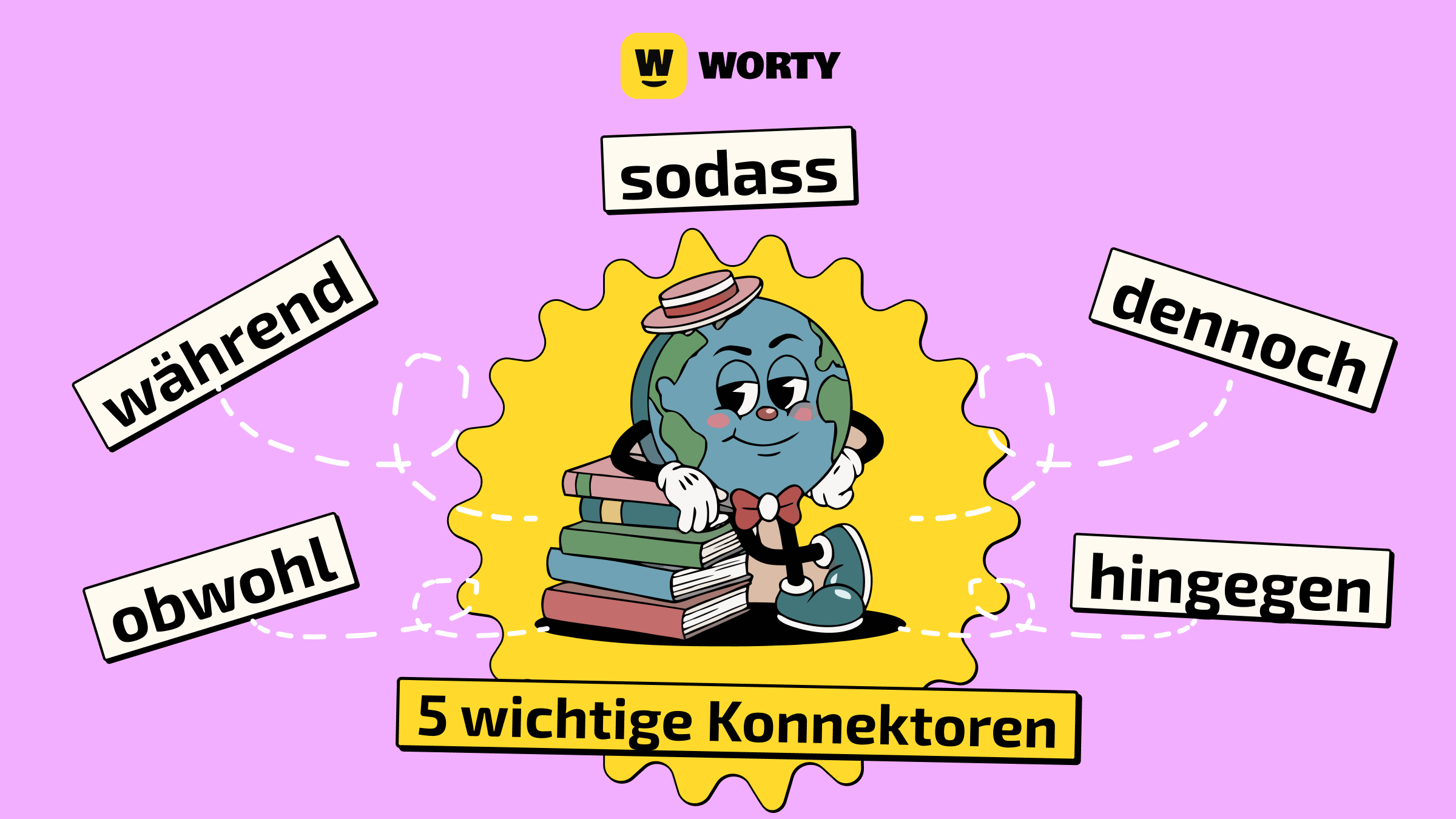
If you're learning German at B1 or B2 level, connectors like sodass, während, obwohl, dennoch, and hingegen are especially useful. They allow you to express results, contrast, and different points of view more clearly.
In this guide, you'll learn what each connector means, how to use it in a sentence, where the verb goes, and see practical examples with English translations.
1. Sodass — So That / As a Result
Sodass introduces a consequence or result. It tells us what happened as a result of something mentioned before.
In English, sodass can often be translated as "so that", "so", or "as a result".
How to Use Sodass
Sodass introduces a subordinate clause, so the conjugated verb goes to the end of the clause.
Es hat die ganze Nacht geregnet, sodass die Straßen am Morgen überschwemmt waren.
It rained all night, so the streets were flooded in the morning.
Sie hat jeden Tag Deutsch gelernt, sodass sie die Prüfung erfolgreich bestanden hat.
She studied German every day, so she successfully passed the exam.
Sentence Structure with Sodass
Main clause + sodass + subordinate clause with the verb at the end.
Er war sehr müde, sodass er früh ins Bett gegangen ist.
He was very tired, so he went to bed early.
Remember: after sodass, the conjugated verb goes to the end.
2. Während — While / Whereas
Während has two important uses. It can describe two things happening at the same time, or it can contrast two people, things, or situations.
Während for Simultaneous Actions
When während means "while", it describes two actions happening at the same time.
Während ich koche, hört meine Freundin Musik.
While I am cooking, my girlfriend is listening to music.
Er hört Podcasts, während er zur Arbeit fährt.
He listens to podcasts while he drives to work.
Während for Contrast
Während can also mean "whereas" when comparing two different situations.
Während meine Schwester gerne früh aufsteht, schlafe ich lieber lange.
Whereas my sister likes getting up early, I prefer to sleep late.
Während Deutschland viel Wert auf Recycling legt, gibt es in manchen Ländern weniger Recyclingmöglichkeiten.
Whereas Germany places a lot of importance on recycling, some countries have fewer recycling options.
Sentence Structure with Während
Während introduces a subordinate clause, so the conjugated verb goes to the end.
Während er arbeitet, lernt sie Deutsch.
While he is working, she is studying German.
3. Obwohl — Although / Even Though
Obwohl is used to express a contrast or an unexpected result. It means "although" or "even though".
The situation in the obwohl-clause makes the result in the main clause seem surprising or unexpected.
How to Use Obwohl
Obwohl introduces a subordinate clause, so the conjugated verb goes to the end.
Obwohl es kalt war, sind wir draußen geblieben.
Although it was cold, we stayed outside.
Obwohl er wenig Zeit hatte, hat er mir geholfen.
Even though he had little time, he helped me.
Obwohl sie viel gelernt hat, war die Prüfung schwierig.
Although she studied a lot, the exam was difficult.
Important Word Order
If the obwohl-clause comes first, the main clause starts with the conjugated verb immediately after the comma.
Obwohl ich müde bin, gehe ich heute ins Fitnessstudio.
Although I am tired, I am going to the gym today.
Notice the structure: "Obwohl ich müde bin" + comma + "gehe ich".
4. Dennoch — Nevertheless / Nevertheless, Still
Dennoch expresses contrast. It is similar to "nevertheless", "nonetheless", or "still" in English.
Unlike obwohl, dennoch does not introduce a subordinate clause. It is an adverb and can be used in a main clause.
How to Use Dennoch
Es war sehr kalt. Dennoch sind wir spazieren gegangen.
It was very cold. Nevertheless, we went for a walk.
Er hatte wenig Erfahrung. Dennoch bekam er den Job.
He had little experience. Nevertheless, he got the job.
Dennoch can also appear at the beginning of the main clause. When it takes the first position, the conjugated verb comes directly after it.
Es hat stark geregnet. Dennoch sind wir zum Konzert gegangen.
It rained heavily. Nevertheless, we went to the concert.
Obwohl vs. Dennoch
Obwohl and dennoch can express a similar contrast, but their grammar is different.
Obwohl es geregnet hat, sind wir spazieren gegangen.
Although it rained, we went for a walk.
Es hat geregnet. Dennoch sind wir spazieren gegangen.
It rained. Nevertheless, we went for a walk.
Remember: obwohl introduces a subordinate clause, while dennoch connects or modifies a main clause.
5. Hingegen — In Contrast / Whereas
Hingegen is used to contrast two people, things, or situations. It is similar to "in contrast", "by contrast", or "whereas".
Hingegen is especially useful in formal and written German, making it a useful connector for essays, presentations, and exams.
How to Use Hingegen
Mein Bruder liebt den Sommer. Ich hingegen bevorzuge den Winter.
My brother loves summer. I, on the other hand, prefer winter.
Die erste Aufgabe war einfach. Die zweite hingegen war ziemlich schwierig.
The first task was easy. The second, by contrast, was quite difficult.
Einige Studenten lernen lieber morgens, andere hingegen lernen abends.
Some students prefer studying in the morning, while others, on the other hand, study in the evening.
Position of Hingegen
Hingegen is flexible, but it often appears after the subject or at the beginning of the contrasting part of the sentence.
Ich hingegen sehe das anders.
I, on the other hand, see it differently.
Unlike sodass, während, and obwohl, hingegen does not send the verb to the end of the sentence.
Quick Comparison: 5 German Connectors
These five connectors express different relationships between ideas.
Table:
| Connector | Meaning | Main Function | Word Order |
|---|---|---|---|
| sodass | so that / as a result | result or consequence | verb at the end |
| während | while / whereas | time or contrast | verb at the end |
| obwohl | although / even though | unexpected contrast | verb at the end |
| dennoch | nevertheless / still | contrast | normal main-clause word order |
| hingegen | in contrast / whereas | comparison or contrast | normal main-clause word order |
The Most Important Difference to Remember
The biggest grammar difference is whether the connector creates a subordinate clause or a main clause.
Subordinate Clause Connectors
Sodass, während, and obwohl introduce subordinate clauses. The conjugated verb goes to the end.
Obwohl ich müde bin, gehe ich zur Arbeit.
Although I am tired, I am going to work.
Ich lerne Deutsch, sodass ich die Prüfung bestehen kann.
I am learning German so that I can pass the exam.
Main Clause Connectors
Dennoch and hingegen do not send the conjugated verb to the end.
Es war schwierig. Dennoch habe ich es geschafft.
It was difficult. Nevertheless, I managed to do it.
Mein Bruder mag Kaffee. Ich hingegen trinke lieber Tee.
My brother likes coffee. I, on the other hand, prefer tea.
5 Useful Sentences to Remember
If you want to start using these connectors today, memorize these five natural examples.
Es hat stark geregnet, sodass wir zu Hause geblieben sind.
It rained heavily, so we stayed at home.
Während ich lerne, hört mein Bruder Musik.
While I am studying, my brother is listening to music.
Obwohl ich müde bin, lerne ich weiter.
Although I am tired, I keep studying.
Es war teuer. Dennoch habe ich es gekauft.
It was expensive. Nevertheless, I bought it.
Meine Freundin mag den Sommer. Ich hingegen liebe den Winter.
My girlfriend likes summer. I, on the other hand, love winter.
Final Tip
Learning German connectors is one of the best ways to make your German sound more structured and natural.
Don't just memorize the English translation. Pay attention to the grammar that comes with each connector.
Remember: sodass, während, and obwohl send the conjugated verb to the end of the subordinate clause. Dennoch and hingegen work differently because they connect ideas without creating a subordinate clause.
Start by using one or two of these connectors in your own sentences. Once they become familiar, add the others to your active vocabulary.
Keep learning useful German vocabulary and grammar with Worty.
More Articles
15 German Modal Particles You Need to Know to Sound More Natural
German speakers use tiny words like doch, mal, ja, schon, eben and halt all the time. But for German learners, these words can be surprisingly difficult to understand.
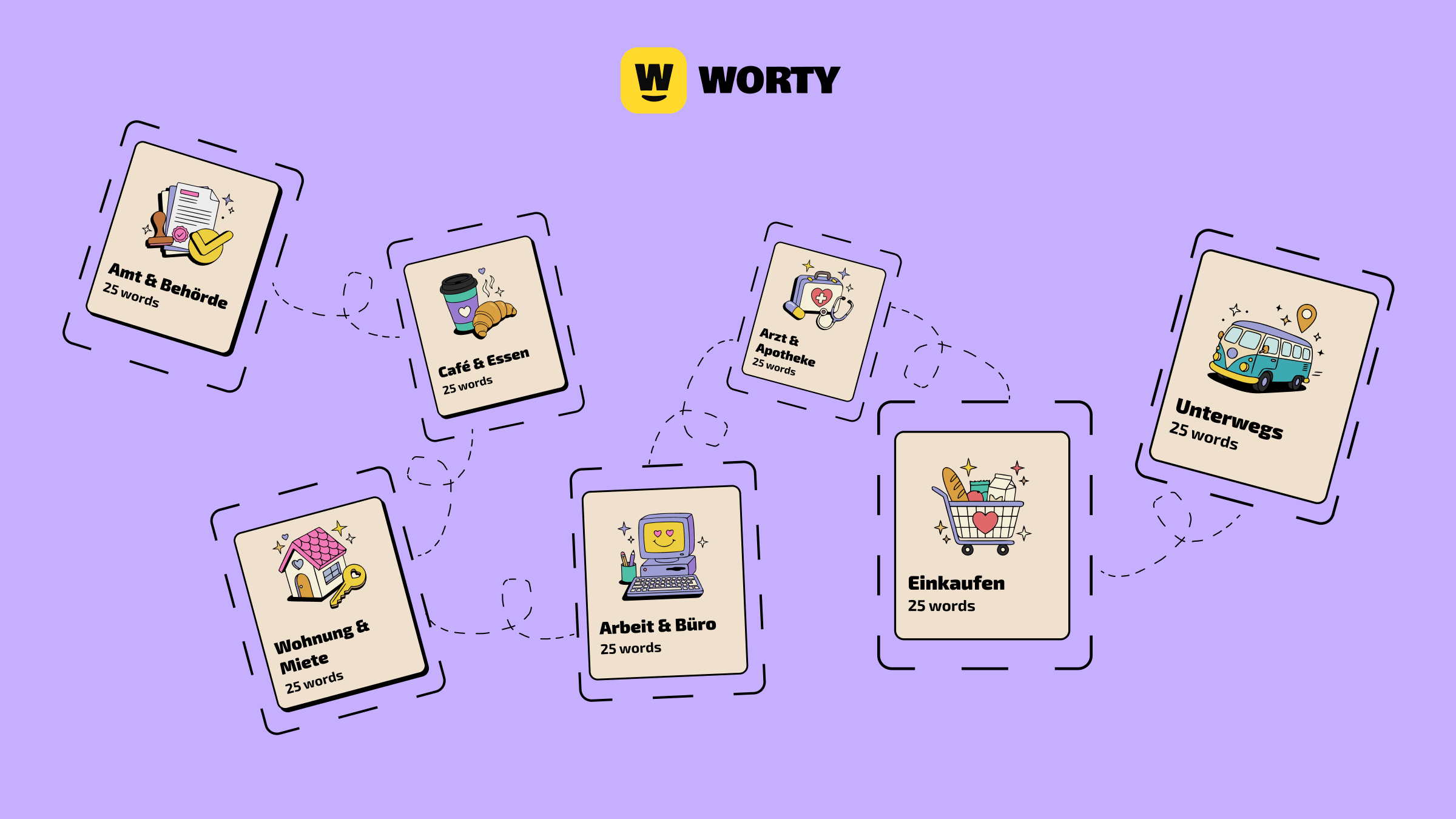
New Card Decks: German Vocabulary for Everyday Life
8 German Antonyms You Should Know
30 German Words You Need to Know at B1 Level
Know at B1 Level A practical list of 30 essential German words that will help you understand conversations and express yourself more naturally.